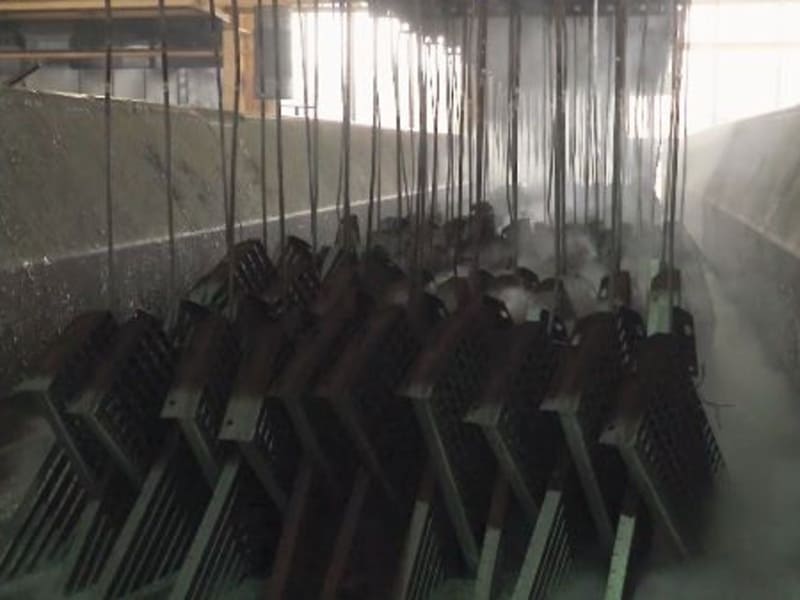
Hot-dip galvanizing protects steel gratings against corrosion. By immersion in molten zinc at around 450 °C, gratings become corrosion-resistant and more durable.
The reference standard for hot-dip galvanizing is DIN EN ISO 1461.
Galvanizing – immersion in molten zinc
Powder Coating
A finishing process in which powder paint is applied to the grating and then cured in an oven at 200 °C.
Powder coating allows a wide color range and creates uniform, durable finishes on metal gratings (gloss, matte, textured, etc.).
It is popular in architecture due to its aesthetic, design-oriented character.
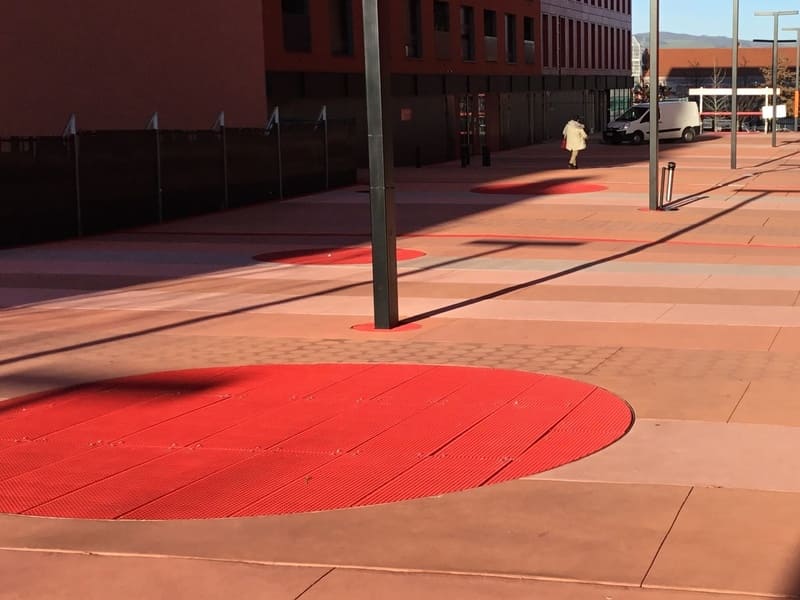
Grating with red powder coating on the forecourt of a railway station
KTL Coating (Cathodic Dip Coating)
KTL is an industrial coating process that ensures an even paint layer on metal parts.
The grating is immersed in a bath of water-based conductive paint and connected as a cathode. Using direct current, pigments migrate to the metal surface, coating the entire immersed part uniformly. The coating is then cured at approx. 180 °C.
KTL is also known as electrophoretic coating or cationic electro-dip coating.
It is widely used in the automotive industry and is also applied in sectors such as aerospace and construction.
Pickling
Pickling removes impurities through chemical or electrochemical reactions, leaving the surface clean and free of grease and oxide layers. This creates a uniform base surface that ensures good adhesion for subsequent coatings. Benefits include improved corrosion resistance, better surface quality and optimal adhesion of passivation layers or additional coatings.
Passivation
Passivation is a process that forms a protective layer on the surface of a metal to slow down corrosion. This layer acts as a barrier between the metal and its environment, protecting it from external influences.
Passivation not only improves corrosion resistance but also enhances the appearance of gratings.
Anodizing (Anodic Oxidation) Anodische Oxidation)
A specific surface treatment for aluminum.
Anodizing forms an oxide layer on the aluminum grating surface (an electrically insulating layer of 5 to 50 micrometers).
This process increases resistance to wear, corrosion and heat. Colored anodizing in accordance with the EURAS color chart is also possible.
Electropolishing
A specific surface treatment for stainless steel.
This process simultaneously polishes and passivates the stainless steel grating.
Electropolished (or polished) stainless steel obtains a smooth surface with particularly high corrosion resistance.
Benefits of Each Surface Treatment
Surface Treatments
Benefits
KTL dip coating
Protects against corrosion and provides good mechanical and chemical resistance
Galvanizing
Increases impact resistance and corrosion resistance
Powder Coating
Creates an attractive, durable protective layer; multiple colors available
Pickling
Removes rust, mill scale and other surface residues
Passivation
Creates a clean, corrosion-resistant surface
Anodizing
Improves wear and corrosion resistance of aluminum grating
Electropolishing
Provides a smooth, corrosion-resistant stainless steel surface

 English
  German